


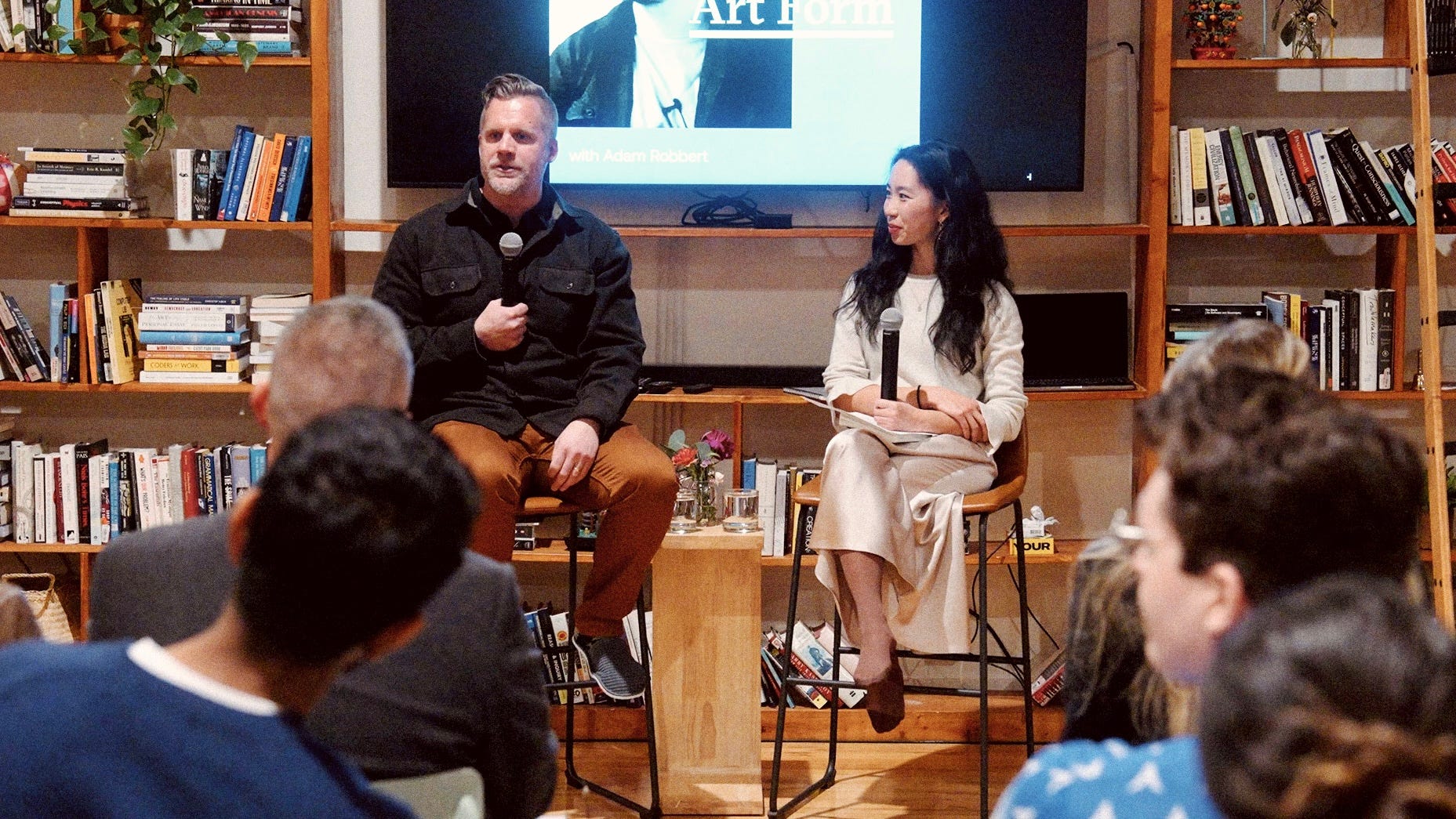
A few weeks ago, we hosted our second Art of Being Human event with philosopher Adam Robbert on attention as an art form. You can watch the full video here:

If you’d like to receive writings, updates, and invites to future events, subscribe here.
1. Attention is the practice beneath all philosophical practices. Nearly every contemplative tradition—Stoic, Platonic, Christian monastic—was built on attention as the foundational practice. Practices like fasting, physical training, and meditation exist to guard the stillness attention requires. Philosophy, in this sense, is a discipline of perception, not mere argumentation.
2. Distraction is a perennial human problem, not a modern pathology. Medieval monks complained that illuminated manuscripts were too decorative and distracting from the text. Socrates bemoaned writing as a technology that would erode our memory. But now, we accept writing as part of the intellectual life. The shape of the distraction changes, but the underlying dynamic doesn’t.
3. Human memory is an ecosystem that must be tended to. Human memory doesn’t store files like a computer, but reorganizes perception at the level of physical sensation. What you attend to shapes your memory, and how reality shows up to you. Writer Eleanor Robins offers a metaphor: your memory is like a garden that you must fertilize with rich material; overconsumption of flat, repetitive media leads to the “desertification” of the inner life.
4. Open-endedness is simultaneously our greatest vulnerability and our greatest strength. A foal can gallop hours after birth, but humans arrive almost unformed. This open-endedness is what makes us susceptible to algorithmic capture and propaganda, but is also what makes self-cultivation through practice possible. We are constitutively shapeable in both directions.
5. Attention and contemplation go hand in hand. Attention is focused, directed, and one-pointed. Contemplation is the opposite: letting go of the seeking, sitting in receptivity, waiting. Often, insights don’t come from willful concentration but from the space that opens when you sit in the silence, darkness, and emptiness without a goal. (For more, read Simone Weil and Simone Kotva’s Effort and Grace)
6. Technology is part of the essence of who we are. In Plato’s Protagoras, Socrates tells this story of Epimetheus and Prometheus. Epimetheus is given the task of assigning essential characteristics to all of the creatures on Earth, but forgets the humans. Then, Prometheus brings humans fire and the technology to create it. So instead of an innate characteristic, humans have the ability to externalize ourselves through technology. Our essence is, in some sense, outside of us. (For more, read Bernard Stiegler.)
7. Individual practice is insufficient for civilizational-scale problems. The cohesive, liturgically structured communities of 14th-century Catholic England provided synchronized collective practice: a shared calendar that organized time qualitatively. We’ve traded that collectivity for individual freedom. But atomized inward practice can’t adequately respond to how technologies are shaping society. It demands a new form of collective institutions, built bottom-up and ecologically, not top-down and monolithically.
8. Values and attention form a virtuous cycle. Aristotle argued that ethics is a habit: you practice by imitating virtuous people, and that starts to transform who you are as a person. Practice, therefore, refines our capacity for moral perception. The more carefully you attend to something, the more it reveals itself—which in turn shapes what you care about.
9. Spaces, both physical and digital, can be designed to afford deeper modes of connection and attention. The suffix of the word “contemplation,” templation, is the same root in the word “temple.” It marks out a space, a clearing, for a certain practice. In architecture and design—including the design of technology and ways of engaging with media—there's opportunity to re-envision new forms of collective practice and exercise, drawing on inspiration from the past.
10. Love is central to contemplation and attention. The deepest traditions of contemplative practice are not mind-centered but cardiocentric (heart-centered). The 14th-century Cloud of Unknowing frames contemplation as “sitting in the love of God” because love is what transcends the limits of perspectival knowledge. There are transcendental questions that knowledge ultimately can’t attain, but loving devotion can help us access.
Our next Art of Being Human event will be on March 25, on cultivating audacity with Courtney Hohne. Courtney is the founder of un/owned, a new kind of innovation lab tackling “ownerless problems,” and spent 10+ years building Google X, the world’s first moonshot factory, as Chief Storyteller. RSVP here.
As always, we welcome your thoughts!
Absolutely love your writing. Point 7 gives me hope and reassurance in building the Quiet Brain Club.
Great reflections Ashley. I'd push back on thesis #2.
Distraction may be perennial, but the current attention economy works through a qualitatively different mechanism. Variable reinforcement, infinite scroll, and algorithmic feeds do not just compete for conscious focus. They train the nervous system into the same defensive narrowing trauma produces: constriction, shortened time horizons, and collapse of presence.
The monks' complaint about illuminated manuscripts was about beauty pulling the eye. What we face now is engineered dysregulation at population scale.
That distinction changes where the intervention lives. If distraction is perennial, the answer is better discipline or better institutions. If the attention economy is a mass dysregulation system, neither willpower nor legislation reaches the actual site of damage. You can't legislate your way to resonance. You can't detox your way to depth.
I explore this further in The Attention Wound: What the Attention Economy Extracts and What the Body Cannot Surrender
https://yauguru.substack.com/p/the-attention-wound?r=217mr3